Your bathroom deserves more than white walls and good intentions. In 2026, the most beautiful bathrooms are bold enough to have a mood, soft enough to feel like a sanctuary, and personal enough to feel like you. Whether you are renovating from scratch or just craving a refresh, these color ideas will make you want to linger a little longer in the room you used to rush through.
1. Warm Terracotta With Creamy Whites
There is something quietly magnetic about terracotta in a bathroom. It carries the warmth of sun-baked earth without feeling heavy, and when paired correctly, it transforms a functional room into something that feels curated, lived-in, and deeply comfortable. In 2026, this earthy reddish-orange tone is making a strong comeback — not in a 1970s harvest gold way, but in a much more refined, modern-artisan direction. Think matte terracotta walls with subtle variation in tone, the kind that looks hand-applied rather than rolled on from a paint can. That textural imperfection is part of the charm.
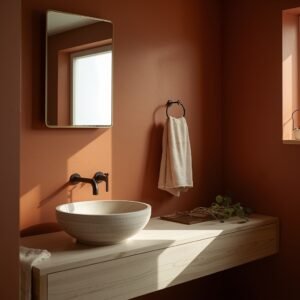
The real magic happens when terracotta meets creamy white accents. Picture a chunky white ceramic vessel sink resting on a whitewashed oak vanity, or thick cotton towels in off-white draped over a simple hook. These soft neutrals give your eye a place to rest without flattening the warmth of the walls. To keep it from feeling rustic or dated, introduce modern fixtures: a sleek matte black faucet, frameless mirror with a thin brass edge, or a narrow floating shelf in pale ash wood. These modern touches signal intentionality rather than nostalgia.
Lighting is everything with terracotta. Natural light will shift the tone from burnt amber in the morning to a dusty rose glow in the afternoon — and both are stunning. In the evening, warm-toned bulbs (around 2700K) will deepen the color into something that feels almost candlelit. Avoid cool white overhead lighting, which will strip the warmth right out of this palette and make it look muddy. A small rattan pendant or an aged brass wall sconce flanking the mirror will complete the look and keep the energy soft, warm, and intentional.
2. Moody Midnight Blue With Warm Brass Accents
Midnight blue in a bathroom is a commitment, and that is exactly why it works so well. It says you are not afraid to make a decision. In 2026, deep navy and midnight blue tones are showing up on walls, cabinetry, and even ceilings, turning bathrooms into intimate, almost jewel-box-like spaces that feel luxurious without requiring a massive budget. The key is understanding that dark colors do not make a space feel smaller — they make it feel defined. When every surface reads as intentional, the room gains presence.
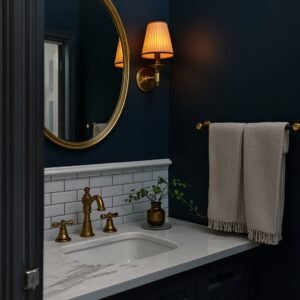
Brass is the natural partner for midnight blue, and the pairing feels timeless for good reason. Warm metallic tones cut through the depth of the blue and create visual contrast that reads as high-end. Consider unlacquered or aged brass fixtures — a faucet, towel bar, and cabinet pulls — rather than polished brass, which can feel too shiny or 1980s. Add a scalloped or ribbed brass mirror, and suddenly the whole composition has a boutique hotel quality. Layering in white or cream elements — a porcelain toilet, white subway tile wainscoting, or a marble-look countertop — prevents the palette from becoming overwhelming.
For lighting, this is where many people go wrong with dark bathrooms. You want warmth, not brightness. A single recessed overhead light will feel clinical and will flatten the richness of the blue. Instead, lean into layered lighting: a warm-toned vanity light above the mirror, a small dimmer-controlled ceiling fixture, and perhaps a small table candle or LED candle on the counter for evening atmosphere. The goal is a bathroom that feels cozy at night and editorial in the day. Dark paint also hides imperfections beautifully, which is a very practical bonus.
3. Sage Green With Natural Stone Textures
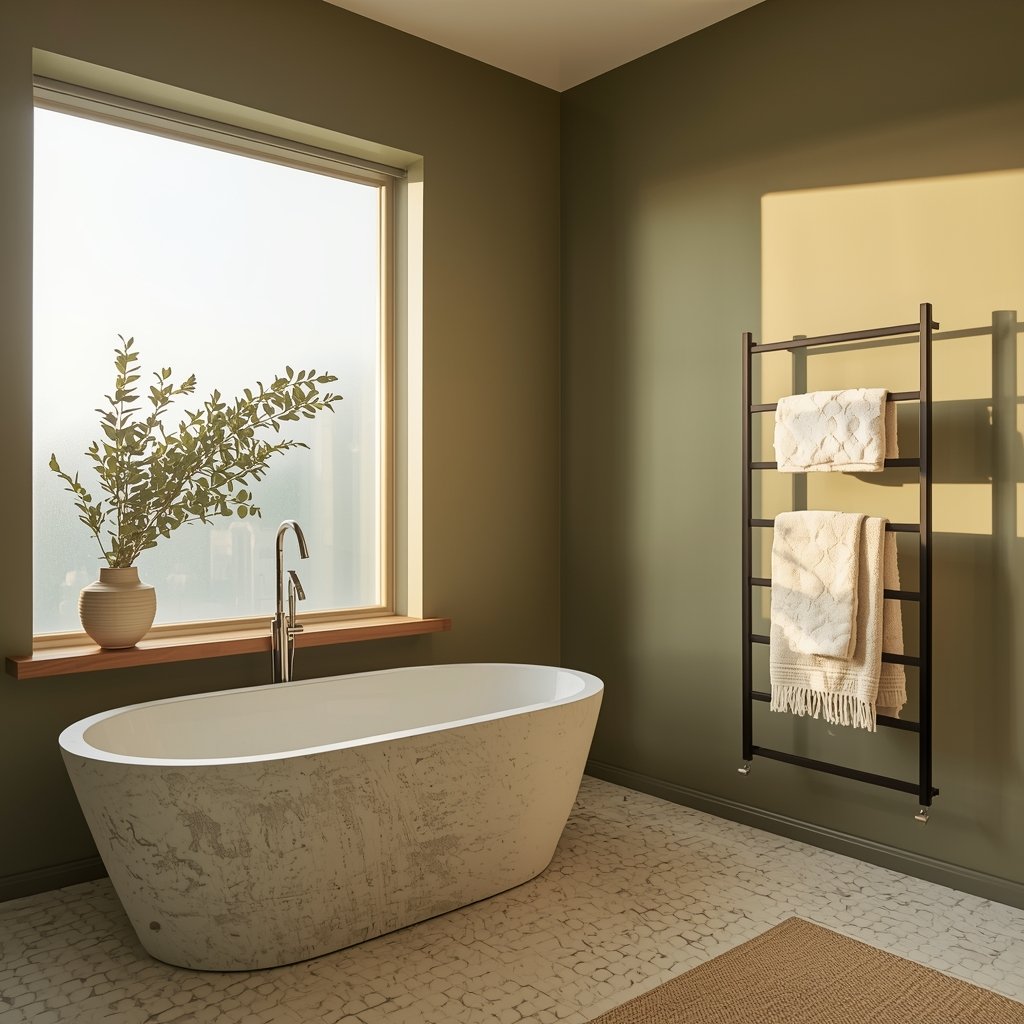
Sage green is the color that refuses to go out of style, and in 2026 it is evolving. Gone are the slightly gray-green versions that dominated the early 2020s. The new sage is warmer, earthier, and more botanical — leaning toward olive at times, then shifting to a muted mint depending on your light source. This living quality is exactly what makes it such a satisfying bathroom color. It breathes. It shifts with the day. It makes you feel like you are washing your face in a greenhouse or a quiet countryside inn.
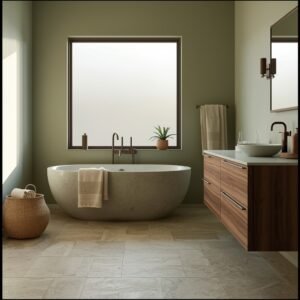
Natural stone is sage green’s best friend in a bathroom setting. Think honed travertine floor tiles with their soft beige veining, or a stacked stone feature wall behind a freestanding tub. Even a simple stone soap dish or a travertine tray on the vanity introduces that organic texture that makes sage feel grounded rather than trendy. Pair the stone with warm wood tones — teak or walnut work beautifully — in the form of a vanity base, a bath mat-width wood plank shelf, or a wooden-handled scrub brush kept in a rattan basket on the floor.
The mood you are after with sage and stone is earthy calm — like a spa that grew out of a forest floor. To maintain that feeling, keep accessories minimal and tactile. A linen hand towel in undyed natural beige, a bar of handmade soap with botanical bits on top, and a small succulent or trailing pothos on the windowsill. Avoid metallics that are too shiny here; brushed bronze or matte iron fixtures will complement the palette far better than chrome. Soft diffused lighting from a frosted globe pendant will tie everything together beautifully.
4. Soft Blush Pink With Sculptural Plaster Walls
Blush pink in 2026 is not the millennial pink you remember from 2016. It has grown up. Today’s blush leans warmer and dustier — closer to the inside of a seashell than a ballet flat — and it is being applied to walls with plaster or limewash techniques that give the color genuine depth and texture. When light moves across a limewashed blush wall, it creates a living, breathing surface that a flat paint simply cannot replicate. This is a bathroom color that photographs beautifully and feels even better in person.
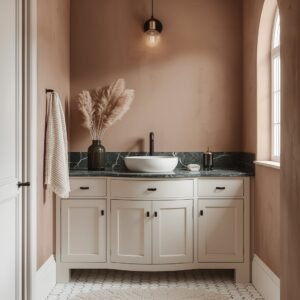
The styling approach for blush should be intentional softness layered with one unexpected edge. Pair the warm pink walls with creamy plaster or ceramic fixtures, a round vessel sink, and curved cabinetry hardware to keep the language soft and organic. Then introduce one grounding element that prevents the room from feeling overly precious: a dark veined marble countertop in deep green or charcoal, a single matte black towel hook, or a low Japanese-style wooden stool in dark walnut. That contrast is what separates a considered design from something that simply looks pink.
Texture layering is essential in a blush bathroom. A bouclé bath mat in ivory, a waffle-weave hand towel, a ribbed glass bud vase on the countertop — each of these adds sensory interest without adding more color. This is a monochromatic space that survives on variation in texture alone, which is genuinely impressive when executed well. For lighting, choose warm Edison-style bulbs in an exposed ceramic wall sconce, or a small arched table lamp on a corner shelf. The warmth will deepen the blush into something that feels more like a sunset than a nursery.
5. Deep Forest Green With White Zellige Tile
There is a reason deep forest green continues to appear on the most saved bathroom boards on Pinterest: it feels both timeless and completely of-the-moment. In 2026, the approach that is resonating most is pairing that rich, dark green with white handmade zellige tile — those slightly irregular, glossy Moroccan-style tiles that catch light differently at every hour of the day. The combination creates a bathroom that feels simultaneously rustic and high-design, earthy and refined. It is one of those pairings that seems like it should not work and then absolutely does.
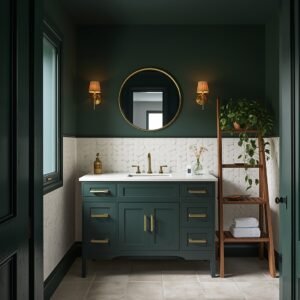
The vanity in a forest green bathroom should either match the wall color — creating a tonal, immersive effect — or contrast in warm natural wood. Both work well for different reasons. A matching green vanity gives the room a moody, enveloping quality that feels very editorial. A warm wood vanity with a forest green wall behind it feels more organic and relaxed. Either way, bring in aged or unlacquered brass hardware and fixtures to introduce warmth. A round brass mirror with a thin frame and a single warm-toned bulb wall sconce will give you that boutique hotel quality without requiring an interior designer.
Do not overlook the ceiling in a deep-toned bathroom. Painting it the same forest green as the walls creates a cocoon effect that is surprisingly wonderful in a small bathroom — it removes the visual stop that a white ceiling creates and makes the space feel more intentional and complete. Keep the floor light to anchor the room: white zellige floor tiles, pale travertine, or large-format white stone all work. A simple indoor plant — a monstera, a bird of paradise, or even a trailing pothos — placed on the floor or on a wooden ladder shelf will make the green walls feel as natural as they are beautiful.
6. Warm Taupe and Greige With Soft Organic Curves
Taupe and greige are the quiet achievers of the color world. They never compete for attention, yet somehow every bathroom they appear in looks thoughtful, calm, and expensive. In 2026, these warm neutral tones are being paired with organic curves — rounded vanities, oval mirrors, arch-shaped niches — and the result is a bathroom that feels more sculptural than functional. The curves soften the already soft palette into something that feels almost Mediterranean in its relaxed elegance. It is neutral done with genuine intention.
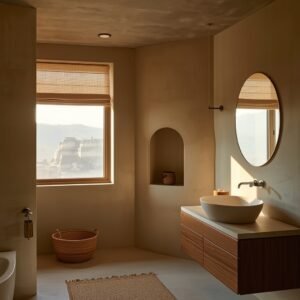
The textures you choose within a greige bathroom matter more than the color itself, because with such a restrained palette, texture becomes your primary design tool. A limewash or microcement wall finish will add subtle movement to an otherwise flat color. Pair that with a matte ceramic sink in the same tonal family, a linen roman shade on the window, and a woven seagrass basket holding spare toilet rolls on the floor. Each of these materials adds a layer of tactile interest that prevents the room from reading as beige-and-boring. The secret is to stay within the same warm tonal range and let the materials do the talking.
Lighting transforms taupe more dramatically than almost any other color. Cool light makes it look flat and slightly gray. Warm light — especially natural golden hour light or warm LED bulbs around 2700K — pulls out the pink and honey undertones that make greige genuinely beautiful. Position a large oval mirror to bounce natural window light around the room. Add a small dimmable sconce beside the mirror for morning and evening use. And if you can manage it, a single candle in a low ceramic holder on the edge of the tub will shift the entire mood of the room into something genuinely serene by evening.
7. Dusty Lavender With Brushed Silver and Marble
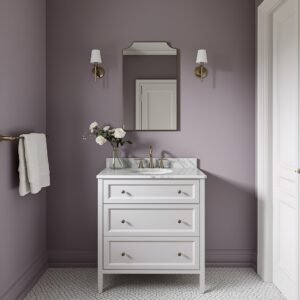
Lavender has re-entered the bathroom conversation and this time it has arrived with considerably more sophistication than its pastel predecessors. The version worth paying attention to in 2026 is dusty lavender — a color that sits closer to gray or mauve than purple, soft enough to read almost as a neutral in certain lights, yet distinctly violet when the morning sun hits it directly. This ambiguity is precisely what makes it interesting. It shifts with the light and keeps the room feeling alive across different times of day.
Brushed silver is the metal finish that works best with dusty lavender, and here is why: it carries the same cool undertone as the color without the brightness of chrome or the warmth of brass, which can muddy the palette. A brushed silver faucet, towel bar, and cabinet pulls will feel cohesive and understated. Introduce white Carrara marble — either on the countertop, in a simple floor tile, or as a small accessory tray — and the room gains a classic, almost Parisian quality. A frameless mirror with a thin brushed silver frame ties everything together without drawing attention to itself.
The mood you want here is gently romantic without being fussy. Keep the accessories clean and spare: a ceramic soap dispenser in dusty white, a small bouquet of dried lavender or white roses in a slim bud vase, a thick white cotton bath towel with a simple woven stripe. Avoid overly decorative or ornate elements, as they will tip the room from elegant into cluttered. For lighting, a pair of slim wall-mounted brushed silver sconces flanking the mirror will give you even, flattering light in the morning and a soft ambient glow at night. Layer in a small dimmable overhead for flexibility.
8. Inky Charcoal With Warm Wood and Matte Black
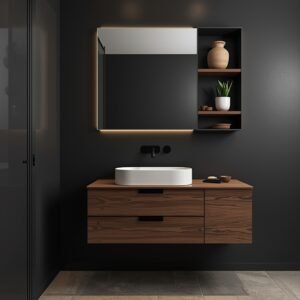
Charcoal bathrooms are not for the timid, and that is absolutely their strength. When executed well, a deep charcoal bathroom feels like the most dramatic and satisfying room in the house — a place that genuinely feels different from every other space. In 2026, the approach that is working best pairs that inky near-black wall color with warm wood tones and an all-matte black fixture palette. The warmth of the wood stops the room from feeling cold or industrial, while the matte black hardware keeps it feeling modern and cohesive.
The vanity is the most important decision in a charcoal bathroom. A floating walnut vanity at mid-height — somewhere between a standard counter height and a lower dresser — brings warmth at just the right visual level, breaking up the darkness of the walls without interrupting the moody atmosphere. Top it with a square or rectangular under-mount sink in matte white and a matte black faucet. Add open shelving in matching walnut above or beside the vanity to hold small ceramics, a folded washcloth, and a succulent. These organic elements are essential — without them, the room risks feeling more like a movie set than a home.
The floor in a charcoal bathroom should be lighter to prevent the room from disappearing entirely. A wide-format light gray or warm beige stone floor tile will anchor the space and allow your eye to rest. Large-format tiles with minimal grout lines are particularly effective here because they keep the floor reading as one calm plane. Lighting must be warm and layered: a recessed dim ceiling light for general use, a warm-toned backlit mirror for task lighting, and — if you can manage it — a small candle or LED candle on a walnut corner shelf for evening ambience. This room lives and dies by its lighting choices.
9. Pale Sky Blue With Coastal Linen Textures
Sky blue in a bathroom never really left, but the version circulating in 2026 has been thoughtfully updated. It is no longer the bright, slightly aqua-leaning blue of coastal beach houses from ten years ago. Today’s sky blue is paler, grayer, and more considered — a color that sits between a clear winter sky and a pale watercolor wash. It feels airy without feeling cold, clean without feeling clinical. In smaller bathrooms especially, this pale blue creates an almost optical illusion of space and light that no white wall can quite replicate.
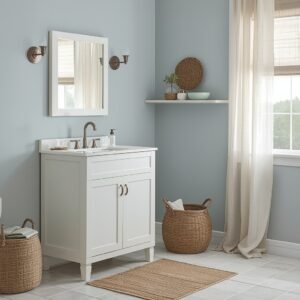
The textures that work best with pale sky blue are natural and relaxed: raw linen, unbleached cotton, coarse-woven jute. A linen window shade in undyed natural fiber, a woven cotton bath mat in oatmeal, a rough-hewn driftwood shelf mounted on the wall — all of these bring a coastal sensibility that is calm and understated rather than kitschy nautical. Avoid anchors, shells displayed in fishbowls, or any other literal ocean motifs. The coastal feeling should come entirely from the texture and the palette, not from decorative references. That restraint is what keeps it feeling like a well-traveled home rather than a vacation rental.
For fixtures and hardware, a brushed nickel or warm brushed chrome will complement the pale blue far better than stark chrome or brass. Keep lines simple and fixtures unfussy — a basic gooseneck faucet, a simple rectangular mirror, a flat-front vanity in white or pale gray. Introduce one or two ceramic pieces in a complementary soft tone: a pale celadon soap dish, a matte white toothbrush holder with a slight blue-green glaze. The room should feel like taking a deep, slow breath. Diffused natural light is ideal, and sheer white window panels will protect privacy while still letting the room glow.
10. Rich Rust and Ochre With Black Grout Tile
This is the bathroom color combination that the most adventurous corner of Pinterest has been quietly building toward. Rust and ochre — two colors pulled directly from the warm end of the earth spectrum — combine in a bathroom to create something that feels genuinely new while referencing something ancient. Think old adobe walls in New Mexico, terracotta pottery, the golden dust of a Tuscan road. This palette is warm, earthy, and deeply human in a way that feels like a deliberate pushback against the all-white bathroom of the previous decade.
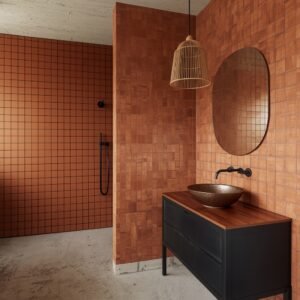
The tile work is where this combination truly comes alive. Picture small square or rectangular wall tiles in a warm rust-orange with contrasting black grout — the dark grout lines create a graphic pattern that turns an ordinary tile layout into something architectural. Behind a freestanding bathtub or along a vanity wall, this becomes a genuine focal point. Keep the adjacent walls in a complementary ochre or raw umber tone — whether in paint, limewash, or microcement — and the room will feel completely cohesive without being monotone. A raw concrete or dark slate floor tile anchors the warmth with a matte, grounding tone.
The accessories in this bathroom should honor the earthy materiality of the palette. A hammered copper or bronze bowl as a vessel sink, a rough-cast ceramic vase in amber glaze on the shelf, a hand-thrown soap dish in chocolate brown. These handmade, imperfect pieces will feel completely at home in a palette that celebrates the beautiful irregularity of natural materials. A matte black faucet and towel hook will provide modern contrast without disrupting the warmth. For lighting, a single warm Edison bulb in a minimal exposed socket fixture, or a small woven rattan pendant above the tub, will cast the kind of amber glow that makes this entire palette feel absolutely alive.