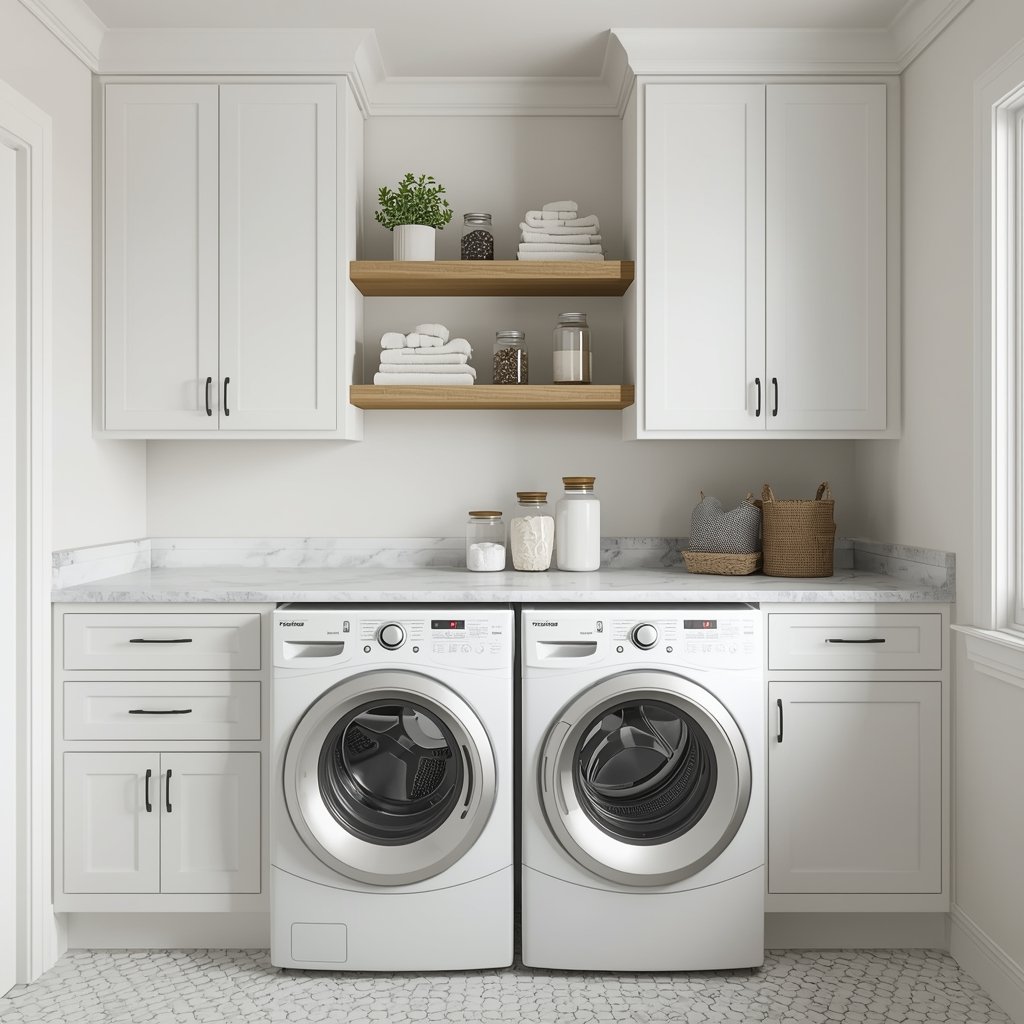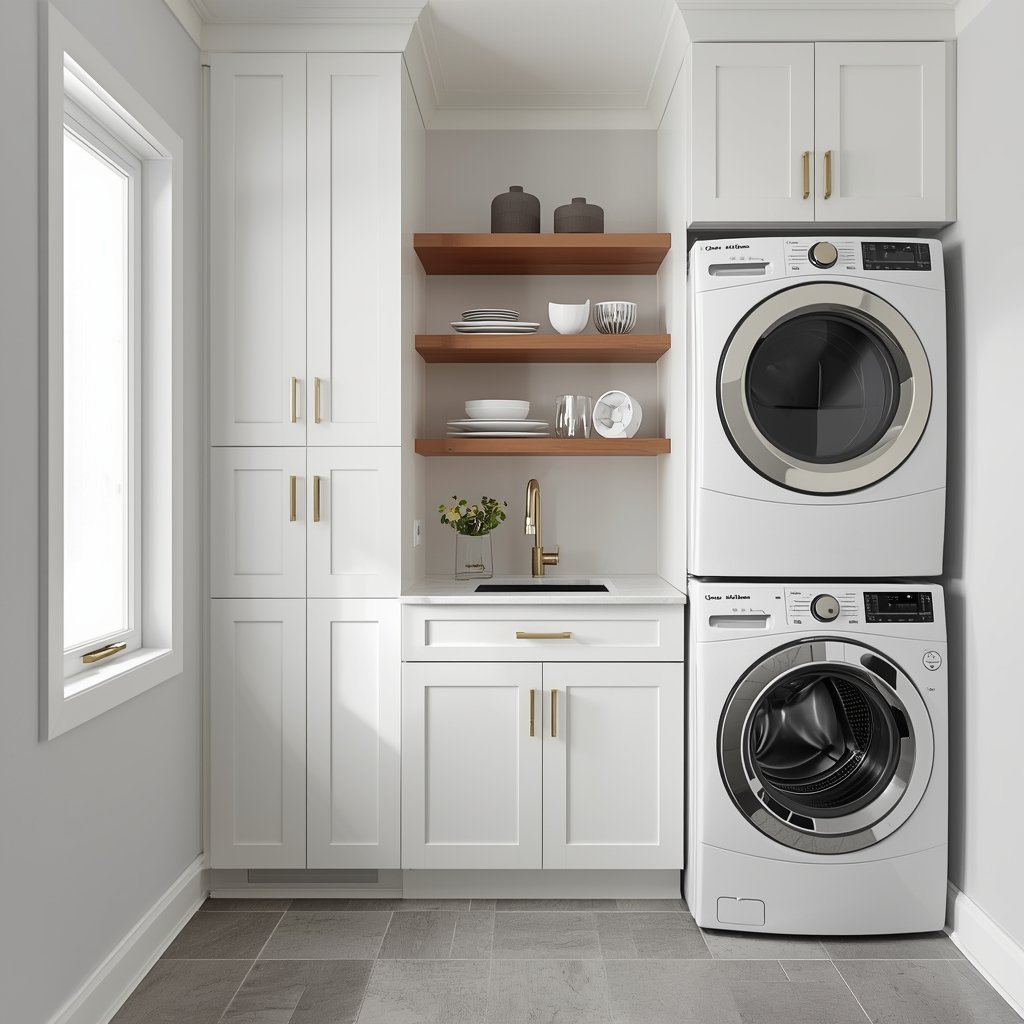
There is something quietly ssfying about a laundry room that actually works for you — a space so well-designed that even the smallest square footage feels purposeful, calm, and beautiful. If your laundry room has been feeling more like a closet you avoid than a room you love, these ideas are about to change everything.
1. Stack It Up: The Power of Vertical Space
When floor space is limited, the only direction left is up. Stacking your washer and dryer is one of the single most effective moves you can make in a small laundry room, and it does not mean sacrificing function. Modern stackable units are available in full-size configurations, so you keep the capacity while freeing up an enormous amount of floor real estate. That cleared space becomes your opportunity — a base cabinet, a rolling hamper, or even a slim pull-out ironing board station can slide right in beside it. Pair the stacked unit with floor-to-ceiling cabinetry on the opposite wall to keep everything balanced and intentional.

The trick to making a stacked setup feel styled rather than just practical is in the finishing details. Frame the unit with simple trim or built-in cabinetry panels so it looks like it was always meant to be there. Choose a matte white or soft greige for the surrounding walls — these tones make the space feel larger and more breathable. Add a thin floating shelf just above the dryer for detergent, a small plant, or a candle. A woven basket tucked at the base keeps stray socks and dryer sheets out of sight. Overhead pendant lighting or a sleek flush-mount fixture in warm white light softens the utilitarian feel and makes the whole room feel curated.
2. The Fold-Down Ironing Board Wall Station
One of the most overlooked space-saving tools in a laundry room is the wall-mounted fold-down ironing board. When it is closed, it looks like a simple cabinet door or a framed panel. When it is open, it gives you a full ironing surface without consuming permanent square footage. These units have come a long way in terms of design — you can now find versions finished in white, wood veneer, or even mirrored fronts that blend seamlessly into a styled wall. Position it at a comfortable standing height and install an outlet nearby so your iron cord is never stretched across the room.

Surround the station with intention. Flank it with small hooks for hanging freshly ironed garments, or mount a slim pegboard panel beside it painted in a contrasting matte tone — deep charcoal or dusty sage work beautifully against white walls. Keep the color palette cohesive: if your cabinetry is white, choose hardware in a warm brass or matte black finish and repeat that metal tone in your hook rail and light fixture. The ironing station goes from afterthought to design feature when everything around it feels considered. A narrow floating shelf just above holds a spray bottle, a linen spray with a pretty label, and a small folded cloth — function and beauty together.
3. Open Shelving With Organized Baskets
Open shelving in a laundry room sounds counterintuitive — does it not just put the mess on display? Not if you approach it with a system. The key is consistency: matching baskets in a natural material like rattan, seagrass, or linen-lined wire create instant visual harmony. Assign each basket a category — darks, lights, delicates, linens — and label them with a simple tag or a hand-lettered card. When the system is in place, the shelving becomes a feature rather than a flaw. Use thick wood shelves in white oak or pine for warmth, and keep them spaced generously so the baskets breathe.

Wall color makes or breaks an open shelving setup. A soft warm white keeps things light and airy, while a moody deep tone — think navy, forest green, or charcoal — makes the natural basket textures pop dramatically and gives the room a boutique feel. Either approach works beautifully depending on the mood you are going for. Add a small trailing pothos or a eucalyptus bundle draped over one shelf edge for softness. Lighting is critical here: under-shelf LED strips or a simple plug-in sconce mounted between shelves casts warm, even light that eliminates shadows and makes the room feel inviting rather than stark.
4. A Sink That Earns Its Place
A utility sink in a small laundry room can feel bulky and institutional — unless you choose it carefully and build the space around it. The right sink changes everything. A undermount or apron-front sink in a matte white or concrete finish reads as intentional and beautiful. Pair it with a simple gooseneck faucet in brushed gold or matte black, and suddenly the utilitarian piece becomes a design anchor. Positioning the sink below a window is ideal — natural light makes hand-washing tasks feel less like a chore and more like a quiet, meditative moment.

For the cabinetry below, skip the standard base cabinet and consider open shelving or a furniture-style vanity stand. This breaks up the built-in look and makes the room feel less cookie-cutter. Store rolled hand towels, a glass soap dispenser, and a small potted herb like lavender on the open lower shelf for texture and scent. On the backsplash, use something with personality — a vintage-inspired zellige tile in soft cream, a handmade look subway tile in warm terracotta, or a simple marble mosaic. Keep surrounding surfaces clean and uncluttered so the sink and backsplash get the attention they deserve.
5. Hidden Laundry Behind Cabinetry Doors
The most elegant small laundry room is often one you cannot tell is a laundry room at all. Concealing your washer, dryer, sink, and supplies behind a wall of cabinetry or a pair of bifold doors creates a sleek, uninterrupted surface that visually expands the space. This approach works especially well when the laundry area shares square footage with a hallway, mudroom, or kitchen. Panel-front appliances — where the washer and dryer faces are covered with cabinetry fronts — take this concept to its most refined level and are increasingly available through major appliance brands.
Choose your cabinet doors wisely. Flat-panel Shaker doors in a soft white or warm linen tone keep the look timeless. For a bolder statement, try a muted sage green or dusty blue — colors that read as furniture-like rather than built-in. Pair with simple bar pulls in unlacquered brass for warmth, or go sleek with touch-to-open mechanisms for a completely hardware-free look. Inside, organize with intention: a small tension rod for hanging delicates to drip-dry, adhesive hooks on the inside of the door for supplies, and a fold-down shelf that doubles as a folding surface when the cabinet is open. Closed, it looks like a beautiful linen armoire. Open, it is a fully functioning laundry station.
6. Peel-and-Stick Tile Floors That Transform the Space
Never underestimate the transformative power of a great floor. In a small laundry room, the floor is one of the most visible surfaces — and upgrading it costs far less than most people expect. Peel-and-stick vinyl tiles have come a long way in terms of quality and realism. You can now find options that convincingly mimic cement tile, encaustic patterns, wood grain, and stone — all in a water-resistant, easy-clean format that is perfect for laundry rooms. A bold pattern — black and white checkerboard, Moroccan-inspired geometric, or a small-scale hex tile in terracotta — instantly gives a plain room a personality transplant.

The magic of a patterned floor is how it draws the eye downward and outward, creating an illusion of more space. Pair a graphic floor with simple, quiet walls in bright white or soft warm cream so the floor is the star. Keep upper elements understated — clean white cabinets, simple hardware, a neutral countertop — and let the tile carry the design weight. Finish the room with a small vintage-style runner beside the machines for softness underfoot if the tiles feel too bold alone. One practical note: always make sure your subfloor is clean, dry, and smooth before applying peel-and-stick tiles for best adhesion and longevity.
7. A Countertop Folding Station That Works Double Duty
Every small laundry room deserves a proper folding surface. Without one, clothes end up folded on top of the dryer, on the floor, or moved to another room entirely — which defeats the whole purpose of an efficient space. A built-in countertop over a front-load washer and dryer instantly solves this problem and adds significant storage potential below. Choose a countertop material that is both durable and beautiful: butcher block adds warmth and texture, quartz in a soft white or warm grey is timeless and stain-resistant, and laminate in a wood-look finish offers a budget-friendly option that still photographs beautifully.
Make the folding station work double duty by pairing it with a wall-mounted drying rack just above — these fold flat against the wall when not in use and extend to hold several garments at once. Add a shallow drawer unit beside the washer for detergent pods, dryer sheets, and small supplies so the countertop surface stays clear and clean. If you have a narrow space between the machines and the wall, a slim pull-out tower cabinet fills that gap perfectly with vertical storage. Style the countertop surface lightly: a small plant in a terra cotta pot, a pretty linen spray bottle, and a ceramic dish for coins and loose change. It is a working surface, but it does not have to look like one.
8. Moody Dark Walls With Warm Accents
Light and airy laundry rooms are beautiful — but there is a growing design movement toward using darker, moodier wall tones in small utility spaces, and the results are quietly stunning. A deep charcoal, inky navy, or forest green wall gives a small laundry room a cozy, intentional quality that reads more like a boutique hotel closet than a utility space. Far from making the room feel smaller, dark tones create a sense of depth and richness that bright white walls simply cannot achieve. The key is contrast: pair dark walls with bright white or warm cream cabinetry, light flooring, and warm metallic hardware for balance.

Lighting becomes even more critical in a dark-walled room. Layer it thoughtfully: recessed overhead lights for general function, under-cabinet LED strips for task lighting at the counter, and perhaps a small decorative wall sconce if space allows. Natural light through even a small window becomes precious — keep window treatments simple or sheer so every bit of daylight gets in. Bring in texture to prevent the dark walls from feeling flat: a rattan basket, a linen hamper, a wooden drying rack, and a small framed print in an ivory mat. The combination of dark walls and warm natural materials creates a space that feels designed rather than utilitarian.
9. A Pegboard Wall for Flexible, Pretty Storage
Pegboards are no longer reserved for garages and craft rooms. In a laundry room, a painted pegboard wall is one of the most flexible, affordable, and visually interesting storage solutions available. Mount it on the wall beside or above the machines, paint it to match or contrast your cabinetry, and then outfit it with a mix of hooks, small baskets, wooden dowels, and shelves. The result is a completely customizable storage system that you can rearrange anytime your needs change — no drilling new holes, no permanent commitment.

The styling possibilities are genuinely exciting. A pegboard painted in a soft terracotta tone becomes an earthy, boho-inspired feature wall. In crisp white against a navy wall it reads as graphic and modern. In matte black with brass hooks and wooden shelves it feels luxe and editorial. Hang your most-used supplies within easy reach — lint rollers, a stain stick, a small spray bottle — and give less-used items the outer edges. Add a few aesthetic touches: a small trailing air plant tucked into a hook-hung terra cotta pot, a linen drawstring bag, or a cluster of wooden clothespins on a hook. The pegboard earns its place aesthetically and practically.
10. A Sliding Barn Door That Steals the Show
If your laundry room opens off a hallway or larger living area, the door itself is a design opportunity too many people ignore. Swapping a standard hinged door for a sliding barn door saves the floor space that a door swing would normally consume — which in a small room can be the difference between a cramped layout and a functional one. Beyond the practical benefit, a well-chosen barn door adds serious visual character. A solid wood door in a natural oak stain brings warmth and texture. A painted door in a contrasting color — dusty rose, sage, charcoal — becomes a bold style statement. A frosted glass panel barn door allows light to pass between rooms while maintaining privacy.

Hardware selection ties the look together. Choose a track and handle that coordinates with the rest of your home’s metals — matte black for a modern farmhouse feel, brushed nickel for a Scandinavian look, or antique brass for a warmer vintage aesthetic. Keep the surrounding wall simple so the door can be the focal point. If your laundry closet is visible from a living or dining area, the barn door becomes part of your main space’s decor — treat it accordingly. Style the wall beside it with a small framed print or a simple hook rail for bags or aprons, extending the intentional design from inside the laundry room outward into the adjacent space.