There is something about a beige living room that feels like a long exhale. It is the kind of space that welcomes you home without trying too hard, that looks effortlessly put-together whether you are hosting guests or curled up alone with a book. Beige is not boring — it is the most quietly confident color a room can wear.
The Bouclé Sofa Moment Everyone Is Obsessing Over
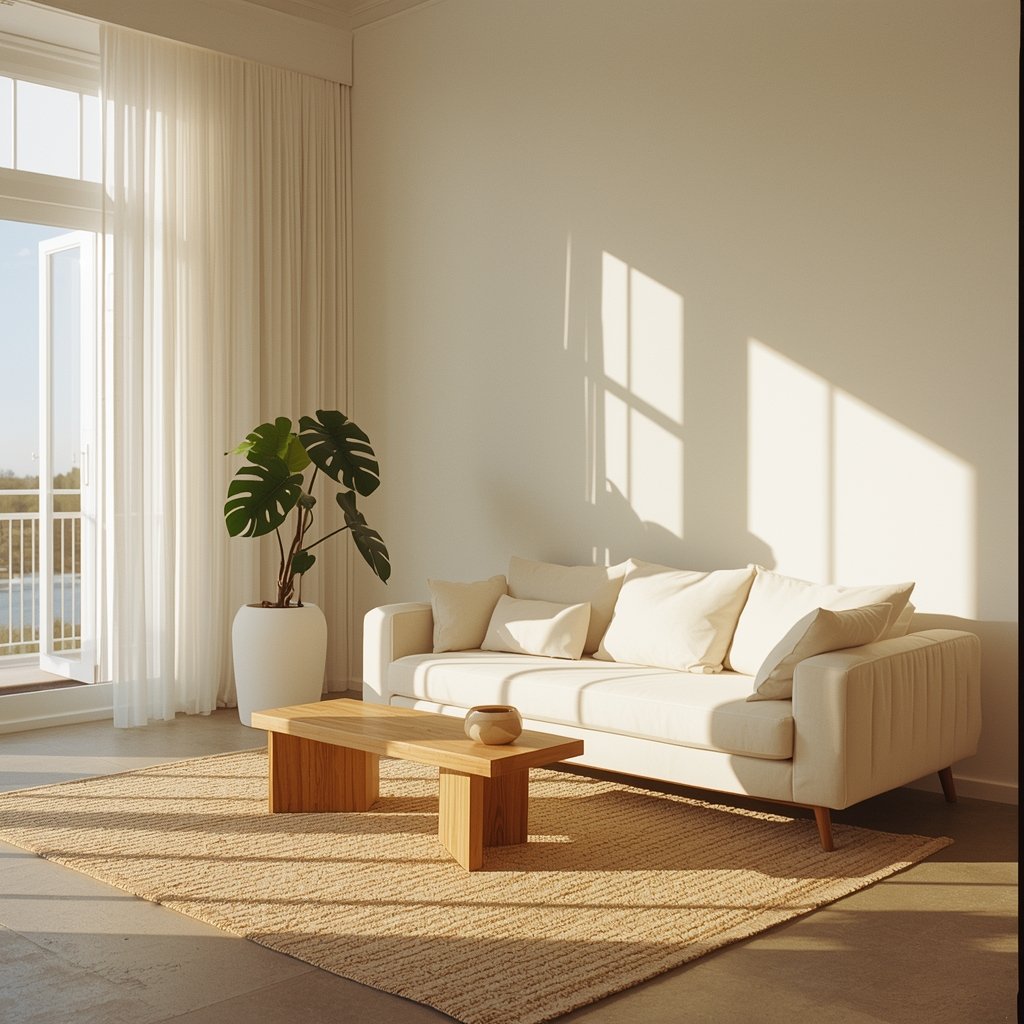
If there is one piece of furniture that has become the unofficial mascot of the modern beige living room, it is the bouclé sofa. That loopy, textured fabric in warm ivory or oat tones has a way of making any space feel instantly curated. The beauty of bouclé is that it does visual work without demanding attention — it adds depth and dimension while keeping the palette serene. Pair it against a warm white or greige wall and you have a foundation that feels both current and completely timeless. The key is to let the texture do the talking rather than layering on too much color.
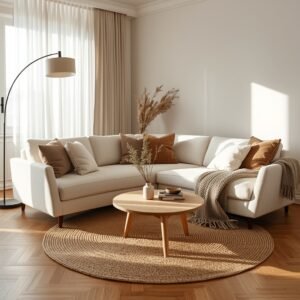
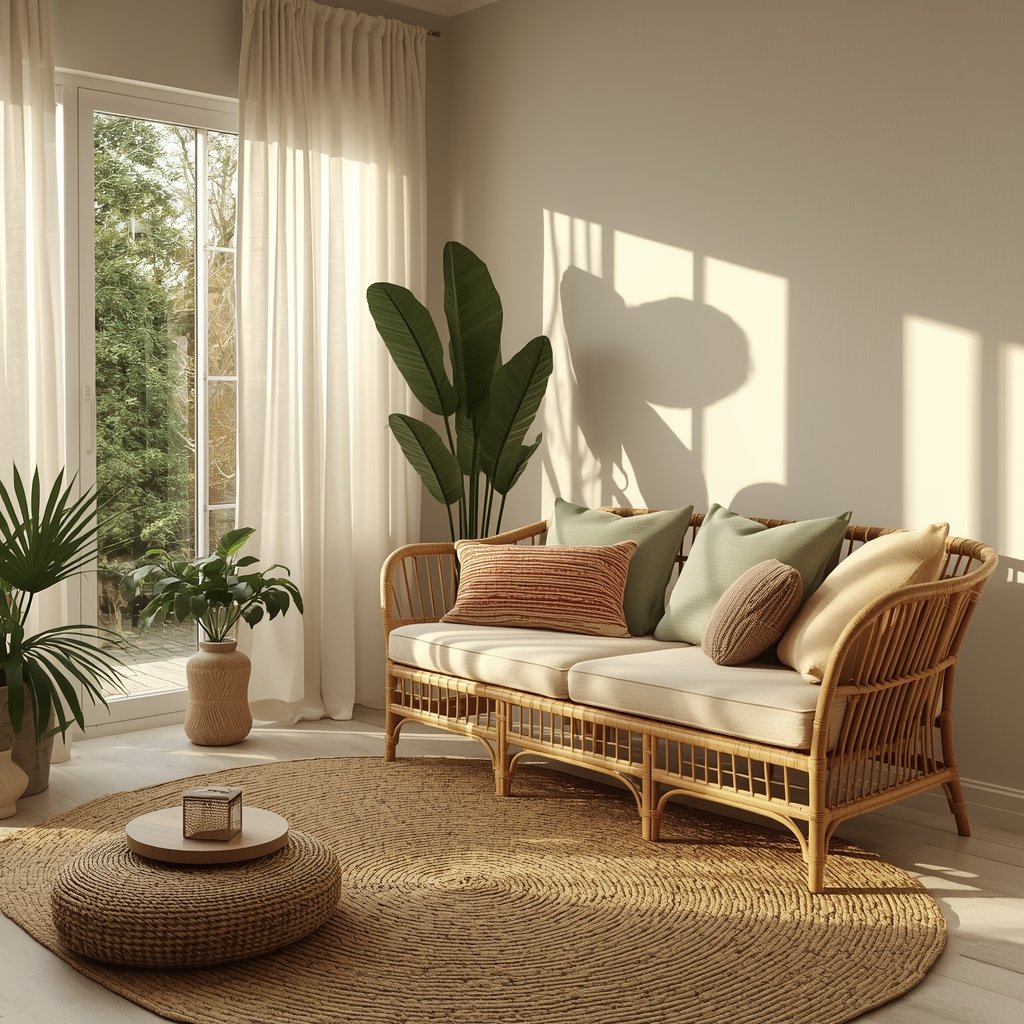
From there, build your room outward in tonal layers. Think warm sand throw pillows, a caramel-colored knit blanket draped casually over one arm, and a woven rattan side table that introduces natural contrast without disrupting the calm. Beige spaces thrive on the layering of similar tones — not flat repetition, but a quiet conversation between shades. Light linen, matte cotton, brushed suede — all of these materials share the same warm undertone but bring different surfaces to the eye. This layering is what keeps a beige room from looking like a blank canvas and turns it into something that feels genuinely considered.
Lighting matters enormously here. In the evening, swap out bright overhead fixtures for a tall arc floor lamp with a linen shade. The warm pooling light it creates will make that bouclé sofa look like the most inviting seat in the world. Add a small rattan tray on the coffee table with a candle or two, and you have created a mood that no color-of-the-year trend can compete with. This setup works in apartments, in suburban homes, in studio spaces — because it is built on proportion and texture rather than statement pieces.
Warm Wood Tones That Ground the Room
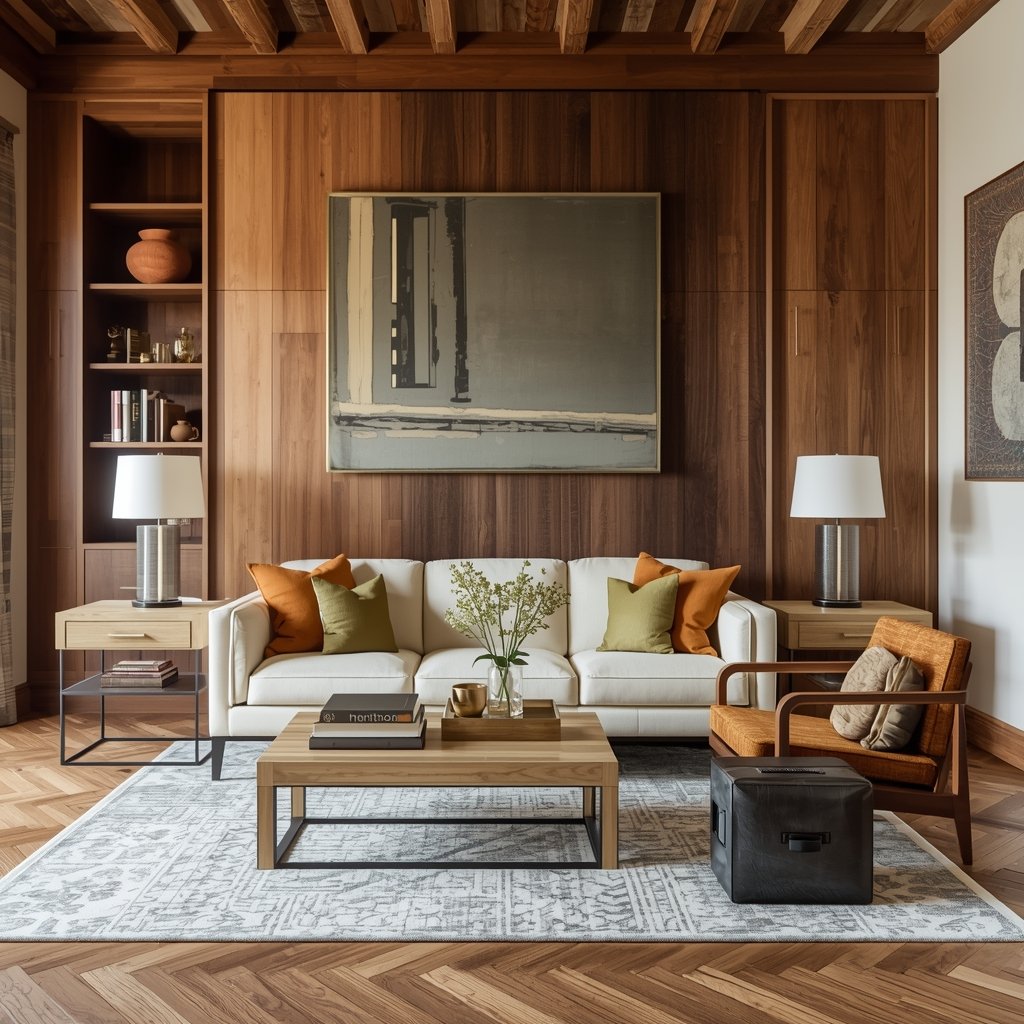
Beige rooms can feel adrift without a grounding element, and warm wood is the most natural answer to that problem. Whether it is a chunky live-edge oak coffee table, a set of walnut floating shelves, or a mid-century sideboard in warm teak, wood introduces an organic richness that prevents a beige palette from feeling washed out. The trick is to choose woods with golden or amber undertones rather than cool gray-washed finishes, which can pull a room in the wrong direction. Honey oak, warm walnut, and light ash all sit beautifully in the beige family, reinforcing the room’s warmth rather than competing with it.
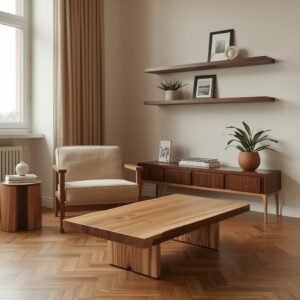
Think about how wood can appear at multiple levels in the space. A low wooden coffee table anchors the seating area. Wooden picture frames or a set of stacked books with warm-toned spines can sit on open shelving. A wooden floor with a natural finish ties every element together from the ground up. When wood appears at different heights and in different forms — tabletop, shelving, flooring — it creates visual rhythm without introducing new color. This is how beige rooms achieve that layered, lived-in quality that looks styled but not overdone.
For furniture pairing, a linen-upholstered armchair in a soft biscuit tone alongside a walnut side table is one of those combinations that just works. It is the warmth of the fabric playing against the warmth of the grain. Finish the area with a small potted plant in a terracotta pot — that slight orange note in terracotta is a perfect complement to warm beige — and hang a simple warm-toned abstract print above the shelving to bring the eye upward. This kind of room looks expensive because every material is working in the same temperature direction.
The Creamy White and Soft Sage Combination
Beige does not always have to stand alone. One of the most quietly beautiful pairings in home decor is beige or cream alongside soft sage green — a combination that feels natural, spa-like, and deeply calming. The sage does not compete; it complements. It brings just enough color to keep the room from feeling monochromatic while staying firmly in the warm, earthy family. Think of it as beige’s most elegant companion. A cream linen sofa, sage green cushions, a sage-painted wall or a set of sage ceramic vases — any entry point into this palette works beautifully.
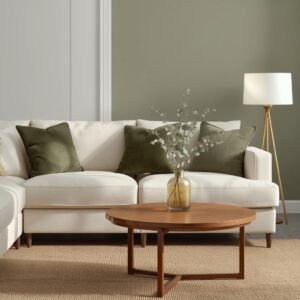
The magic of this combination is that it references nature without going full botanical. You are not filling the room with plants (though a few trailing pothos or a large fiddle-leaf fig never hurt). You are instead borrowing nature’s color language — the sandy ground, the muted leaf — and translating it into textiles and ceramics. A cream boucle sofa with sage velvet cushions on a natural sisal rug reads like a meadow in the most refined possible way. Layer in warm-toned wood accents and the whole room begins to feel like somewhere genuinely peaceful to exist.
For wall treatment in this kind of room, consider painting a single accent wall in muted sage or going even softer with a sage-tinted limewash finish that has natural variation in depth. Against that wall, a simple cream-painted console table with brass hardware and a neutral gallery wall above it creates a focal point that is interesting without being loud. Keep lighting warm and layered — a table lamp with an aged brass base and a cream shade works perfectly in this context. This palette ages incredibly well and never feels like it belongs to one specific trend moment.
Layered Neutrals With Linen Everything
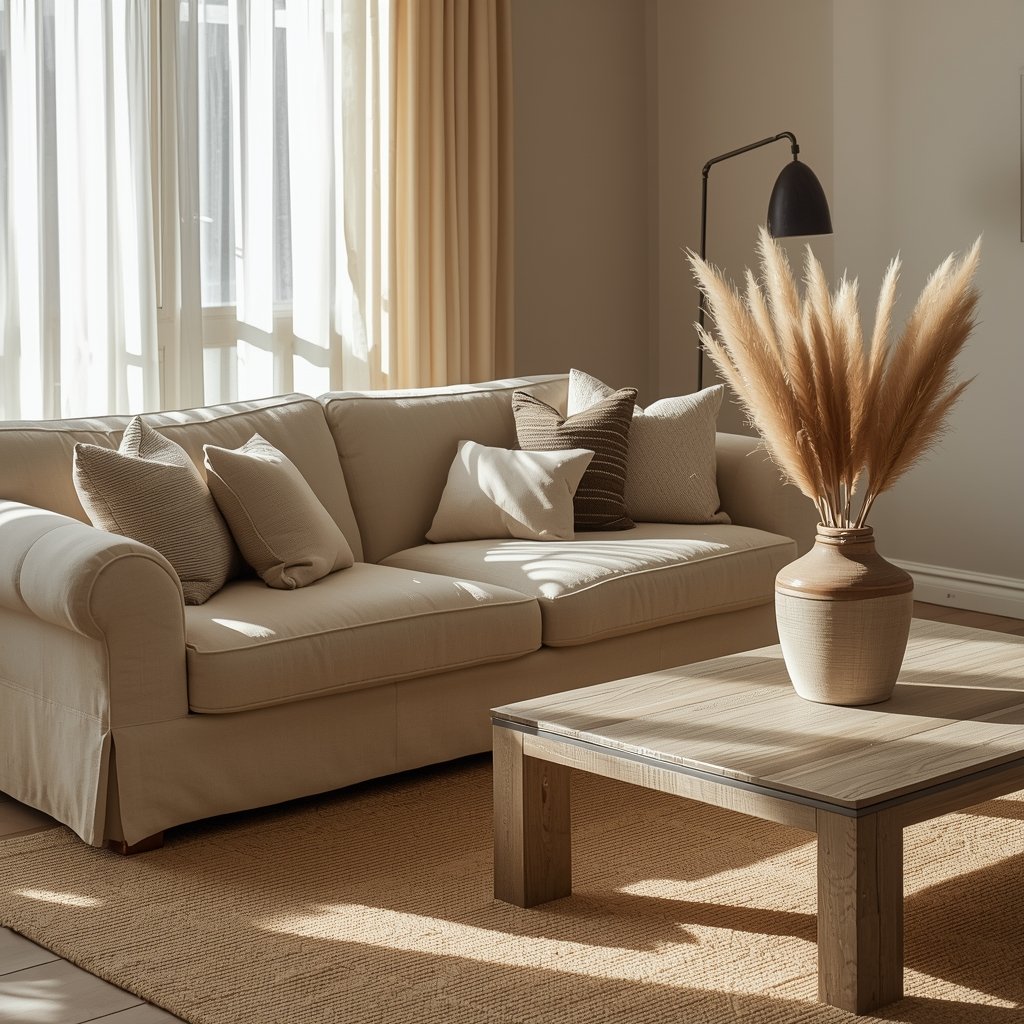
There is a reason linen has become the fabric equivalent of beige — both are effortless, versatile, and deeply satisfying when done well. A living room built entirely around linen textures is one of the most calming spaces imaginable. Think of floor-length linen curtains that pool slightly at the hem, a linen slipcover sofa in natural undyed tone, and linen cushion covers in a range of whites, oats, and warm grays. None of these are the same shade, but they all speak the same language. The variation in texture — smooth weave, slightly coarser weave, heavier canvas — gives the room a richness that a single flat color never could.
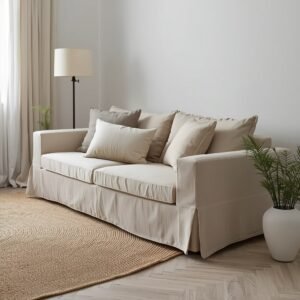
Linen works especially well in rooms with good natural light because it interacts beautifully with sunlight. In the morning, it glows. In the afternoon, it softens. In lamplight, it turns golden. This is a fabric that transforms with the time of day, which means your living room has a built-in lighting system that costs nothing. To keep the palette from becoming flat, introduce contrast through matte black or dark iron details — a simple black-framed mirror, a dark metal floor lamp, a stack of black-spined books. This is one of those decorating moves that sounds counterintuitive but works immediately.
For the floor, a natural jute or sisal rug in a herringbone or braided pattern adds earthy texture that complements linen’s relaxed quality without being too precious. Keep accessories simple: a single large ceramic pot in matte white or warm clay, a tray of smooth river stones or candles on the coffee table, a few framed vintage botanical prints in light wood frames. The principle guiding all of this is restraint — in a linen room, you edit out rather than add in, and the space rewards you for it.
Moody Beige: Dark Walls, Warm Tones
Beige does not have to mean light. One of the most sophisticated and underused approaches to a beige living room is pairing warm neutral furnishings against a deep, moody backdrop — a dark taupe wall, a deep mushroom paint color, or even a rich brown-black that still reads as earthy rather than dramatic. Against these deeper walls, cream and caramel furniture glows. The contrast is warm, enveloping, and surprisingly cozy in a way that light-on-light rooms cannot always achieve. This is the beige living room for people who love the idea of a reading room or a calm evening retreat.
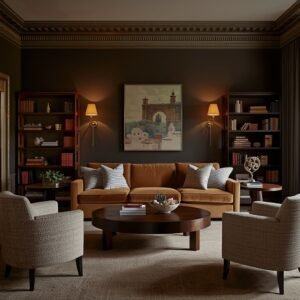
Furniture choices here should lean into plush, substantial forms. A deep-seated sofa in caramel leather or warm cognac velvet becomes the star of the room against a dark moody wall. A set of matching armchairs in cream bouclé creates contrast without breaking the tonal warmth. Avoid hard, cold materials in this setup — chrome, glass, and cool gray do not belong here. Instead, reach for aged brass, dark bronze, and oiled walnut. A heavy wooden bookcase filled with books and objects in warm tones along one wall creates a depth that is almost architectural.
Lighting in a moody beige room should be deliberate and layered. Overhead lighting should be dimmed or eliminated in favor of table lamps, picture lights, and wall sconces — all with warm bulbs in the 2700K range. A pair of brass wall sconces flanking the bookcase, a low table lamp beside the armchair, and candles on the coffee table create exactly the kind of amber-lit environment that makes a room feel like a destination. This look photographs beautifully in the evening and suits anyone who finds all-white interiors a little too bright to relax in.
The Japandi Beige Room: Minimal, Warm, Intentional
Japandi — the design marriage of Japanese minimalism and Scandinavian coziness — finds its most natural expression in the beige spectrum. This style is built on the idea that a room should contain only what is needed, that every object should earn its place, and that warmth comes from material quality rather than quantity of stuff. A Japandi beige living room feels serene in a way that is almost meditative. Low-slung furniture, clean lines, natural materials, and enormous breathing room between objects — this is the visual equivalent of slowing down.
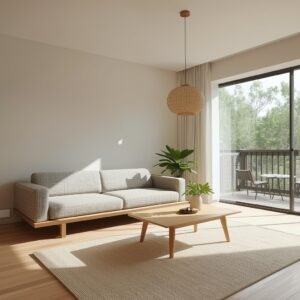
Start with a low platform sofa in warm oatmeal or stone-toned fabric — something linear and clean without being cold. Keep the legs simple: dark wood or matte black. In front of it, place a single low coffee table in natural light ash or bamboo, with nothing on it except perhaps a small ceramic tray. The floor should be visible in large portions — a small natural rug rather than one that fills the whole space sends a clearer Japandi signal. On the walls, a single large piece of art or a simple wooden panel with natural grain provides the visual anchor point the room needs.
Texture in a Japandi space is subtle but present. Think washi paper lamp shades, a hand-thrown matte ceramic vase, a single branch of dried botanicals rather than a full arrangement. Every object has a story, a craft, a simplicity to it. The palette stays firmly in the warm beige and greige range with maybe one moment of very muted charcoal or warm black for contrast. Natural daylight is the preferred lighting tool here — if you can position the sofa to face a window, all the better. In the evenings, a single paper or ceramic pendant lamp overhead and a low table lamp is all the room needs.
Beige and Warm Terracotta Accents
If beige is the base note, terracotta is the note that makes you lean in. These two colors share the same earthy DNA — both rooted in soil, clay, and desert — which is why their combination feels so instinctively right. A beige living room with terracotta accents is warm without being orange-heavy, grounded without being dull, and has a Mediterranean or Southwestern warmth that translates beautifully across many different home styles. The trick is to treat terracotta as a true accent rather than a co-equal partner — it should appear in three to five places throughout the room, enough to feel intentional but not overwhelming.
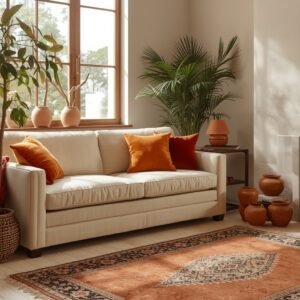
The easiest entry points for terracotta are textiles and ceramics. A pair of terracotta-colored velvet cushions on a cream sofa immediately transforms the room’s mood. A set of terracotta pots — varying heights, grouped near a window — brings in life and color simultaneously. A terracotta-glazed ceramic lamp base on a side table does double duty: functional and decorative. For the floor, a Moroccan-style wool rug with beige and terracotta in its pattern ties all of these elements together in a way that feels globally inspired rather than matchy.
For the larger furniture and walls, keep beige, cream, and warm white doing the heavy lifting. A cream linen sofa, a warm white-painted wall with a subtle texture, a natural wood dining bench pulled into the space — these stay in the neutral lane while the terracotta accents do the work of personality. The mood this creates is relaxed and warm, like a whitewashed room on a warm afternoon. It suits open-plan spaces where the living room flows into a dining or kitchen area, as the terracotta links the areas visually without needing to repaint or reupholster everything.
The Gallery Wall Beige Room
One of the best things you can do for a beige living room is give it a story to tell through a thoughtfully assembled gallery wall. A beige backdrop is the ideal canvas for art — it does not compete, it does not distract, it simply holds the work beautifully. The key to a gallery wall in a beige room is keeping the frames warm-toned: light natural wood, aged brass, or warm matte black all work. The art itself can include abstract prints, black-and-white photography, soft watercolors, or vintage botanical illustrations — as long as the collection avoids anything cold, clinical, or neon.
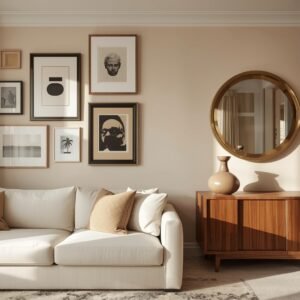
Arrange the gallery wall above a sofa or a low console table so it has an anchor point — floating gallery arrangements in the middle of large walls can feel unmoored. The shapes do not need to match; in fact, mixing square, rectangular, and round frames adds visual interest. Include a mirror in a warm brass or rattan frame within the gallery arrangement — it breaks up the flatness, adds light reflection, and makes the wall feel more dynamic. Keep the spacing tight: a gap of two to three inches between frames reads as intentional, while wider gaps can make the arrangement feel incomplete.
In terms of the rest of the room’s styling, let the gallery wall be the star. Keep the furniture simple and low-profile — a neutral sofa with one textured throw blanket, a clean-lined coffee table with a single sculptural object and a stack of coffee table books. The floor might be where you reintroduce a little pattern through an understated geometric or striped rug. Keep the window treatments airy — sheer linen panels that let light in without blocking it. The goal is that every time someone enters the room, the gallery wall draws them in and tells them something about the person who lives there.
Beige Living Room With Statement Lighting
Lighting is the element most often treated as an afterthought in living room design, and in a beige room, that is a missed opportunity. Because beige is a color that reads differently under different light conditions — warmer or cooler, flatter or more dimensional — the type of lighting you choose is effectively another design decision. A beige room with the wrong lighting can look flat and institutional. The same room with the right lighting becomes layered, interesting, and genuinely beautiful. Statement lighting in a neutral room does something clever: it introduces visual interest without adding more color to the palette.
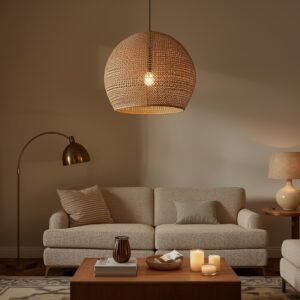
A large sculptural pendant lamp in rattan, woven natural fiber, or matte ceramic immediately draws the eye upward and adds an organic element to the space. Choose a pendant with an open weave if possible — the patterns that light throws onto a beige ceiling and wall become a kind of living artwork when the lamp is on. For task and ambient layers, an oversized arc floor lamp in brushed brass or antique bronze can define the seating area as its own lit zone. A table lamp on each side table ties the room together symmetrically and fills the lower third of the room with warm light.
Beyond the fixtures themselves, the quality and temperature of the bulbs are non-negotiable. Warm white bulbs — 2700K to 3000K — are the only appropriate choice for a beige living room. Anything cooler and the beautiful warm undertones of your furniture and textiles go flat. Dimmer switches on all circuits give you control over mood throughout the day and into the evening. The goal is a room that feels like late afternoon sun indoors, whether it is actually late afternoon or not. This layered lighting approach also means you can photograph the room beautifully at any hour, which for a Pinterest-worthy space is always a bonus.
Cozy Beige With Plush Layers for Autumn and Winter
A beige living room in the cooler months should feel like a warm embrace. The foundation does not change — the same warm neutral walls, the same natural fiber rug, the same linen or bouclé sofa — but the layers you add in autumn and winter transform the feel entirely. Think oversized knit throw blankets in oatmeal and caramel, a second rug layered over the first, velvet cushion covers in deep warm sand or dusty rose, and an abundance of candles in varying heights clustered on the coffee table. These additions cost relatively little but shift the sensory experience of the room significantly.
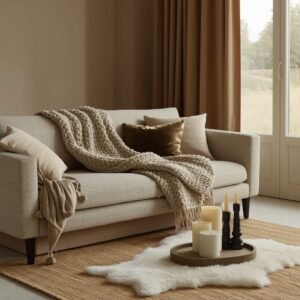
Furniture arrangement matters as much as styling in a cozy beige setup. Pull the sofa and chairs slightly closer together to create a tighter, more intimate conversation cluster. Add an upholstered ottoman that can double as a footrest and a surface for styling. A wood-burning or ethanol fireplace — if you have one — becomes the room’s soul in winter, and every design decision should orient the seating toward it. If you do not have a fireplace, a grouping of large church candles on a stone or marble tray creates a similar focal warmth and draws the eye in the same satisfying way.
Consider swapping out lightweight cotton accessories for heavier seasonal ones as a simple transitional strategy. Summer linen cushions come off; chunky knit covers go on. The sheer curtains can remain for light, but adding a layer of heavier cream or warm oat drapes behind them gives the room a more insulated, cocooned feel. Introduce a seasonal scent through candles or a diffuser — warm amber, sandalwood, or vanilla cedar all sit beautifully in a beige palette and complete the sensory picture. A beige living room in its cozy winter form is one of the most deeply satisfying spaces in domestic design — it is warmth made visible.